
A TALE OF TWO SPECIALS
A story of how two young men, employed as apprentices in the burgeoning, Coventry based, British motor industry, took their interest in cars to the next level.
1 A FORD 8 VAN CONVERSION
My best friend from school, Rex Holbrook, was an apprentice at Armstrong Siddeley, who made aero engines and motor cars. I was an apprentice as an Automobile Designer at the Humber, Coventry, part of the Rootes Group, who made cars, military vehicles and trucks.
In 1954 Rex bought an old Ford 8 Van and between us we converted this into a two seater bodied Special sports car in the style of a Lotus 6 or later Caterham 7. Before the conversion we flogged ourselves pushing the van to get it started. It coughed, spluttered and backfired: I had only just learned that Rootes engines had a firing order 1,3,4,2. and I wired it to suit. We didn’t know that Ford’s had a different firing order 1,2,4,3. The van was dismantled to salvage the chassis frame, power-train and axles for transfer to the patio at the rear of Rex’s parents house.
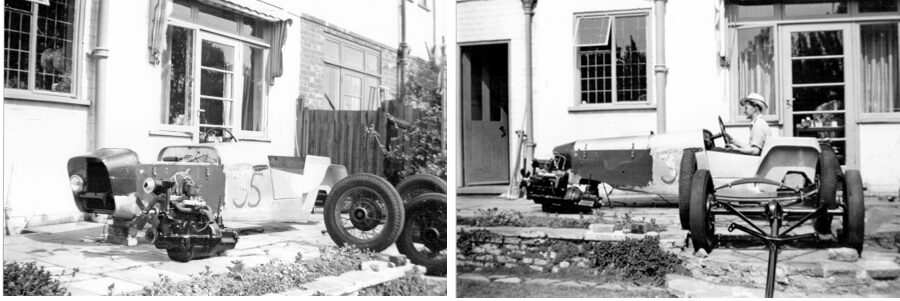
At the Humber in Stoke, Coventry, there was a scrap yard that would sell items to their employees, it became an invaluable source of material. I bought yards and yards of pre-used electrical steel conduit tube, and carried it 2 miles to my home and a further mile to Rex’s home. This tube was used to form the body framework bolted directly to the chassis frame. I did a stint in the Humber Apprentice Training Centre and using their capstan lathe made many female threaded inserts that were an interference fit in the tubes, facilitating bolted ‘T’ joints. Aluminium sheet metal came from Mattersons in Hale Street and was mainly flat with some single plane curves to cover the body. Limited resources meant that the front beam axle could not be divided, in the style of Lotus, to achieve independent suspension. In order to assemble the component parts they had to be carried through a narrow side path to the front of the house.
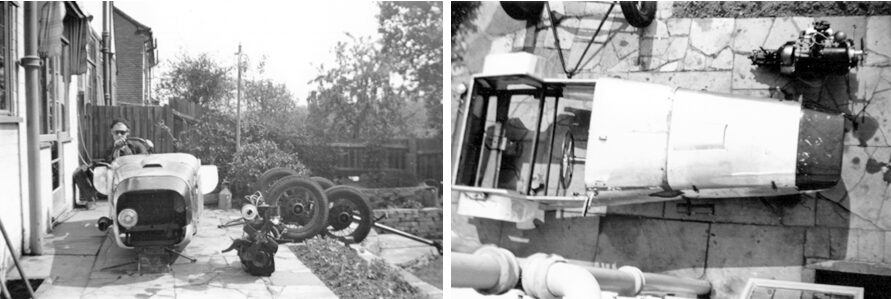
When the car was completed we did some testing at Brandon Speedway car park. Their surface was largely clinker ash. Being interested in Formula 1 racing at the time and seeing how cornering with four wheel drifting was done, on a solo drive I attempted the same without success. I spun the car and was enveloped with a giant cloud if black dust. From a distance Rex must have thought that I had rolled the car but fortunately I hadn’t.
2 HILLMAN ‘TILLY’ CONVERSION
CHASSIS
In 1955 March I bought a scrap worthy ex War Department Hillman Minx based Tilly pick-up truck. It had an integral body construction ie no separate chassis frame. The front half was attached to the rear half almost by the propshaft ! I drove it illegally from Stratford on Avon to home in Coventry one moonless evening, on back roads to avoid detection.
It was installed in my parents back garden, after removal of the fence, onto rough ground.
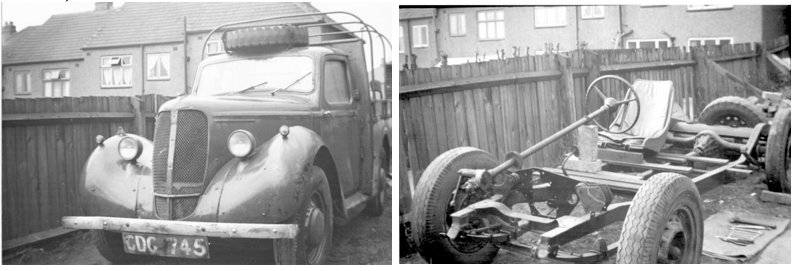
It had heavy duty, highly cambered, rear springs, balloon tyres 6” x 16” and I think a low ratio final drive. (don’t call it a differential!.) It was dismantled and all rusty body parts disposed of. Fortunately I was able to buy a refurbished pre-war Hillman Minx chassis frame, this had box section side members thereby providing a stiff basis for the car.
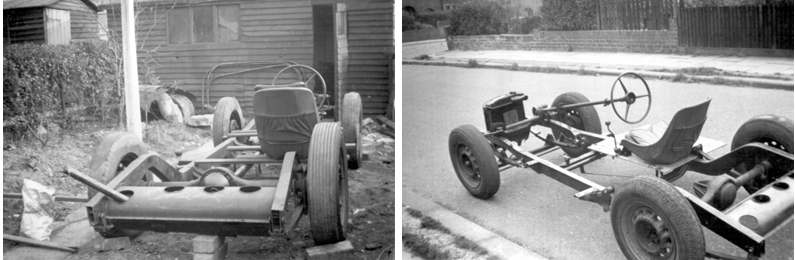
After a painstaking design process I was able to get all the mechanical parts to fit the frame. The first task was to de-rate the rear springs, but I couldn’t afford to have the leaves straightened, so I relocated the front spring eye mounting brackets raising them, and removed some of the leaves to reduce their rate. I can’t remember now whether, at that time, I understood the ensuing roll-oversteer this produced, it certainly proved to be a feature of the car’s handling. I learned to cope with it, when entering a corner, the vehicle would roll causing me to reduce the steering effort. Not a desirable characteristic!
Another undesirable characteristic was the steering action itself. In placing the steering box and column lower and further back, to achieve the desired rearward seating position, it caused the steering drop arm to be misplaced, this can be changed by realigning on the spline. I planned that the drag link front ball joint was in the right place relative to the adjacent road spring, so that the steering was not affected by suspension movement. It was adversely affected when going over a bump causing me to apply steering correction!
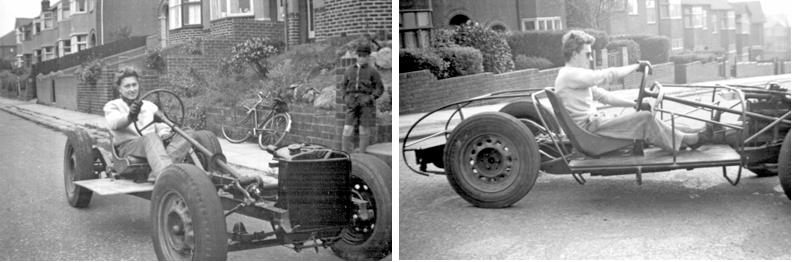
One way and another it was quite a lively car to drive! I studied at Coventry Technical College, opposite was Roache’s car scrapyard; I was a regular visitor and a good purchase was two ex aircraft seats made from lightweight aluminium tubular framework and padded upholstery, ideal for the Special. The Tilly had uncompensated cable operated brakes part of which comprised flexible conduit, I replaced that system with a hydraulic system. The brake pedal pivot was extended through the chassis side member via a bearing bush that was welded in position, this allowed the pedal to be outside the frame The pivot transferred motion inboard to operate the master cylinder by a short lever.
ENGINE
Engines of that vintage, having long strokes and connecting rods, usually had slotted little ends with clamp screw to hold the gudgeon pin. Such rods at high speeds are prone to break and poke a hole in the crankcase. I saw several at Roaches. I was able to source some non slotted rods with floating gudgeon pins. The breathing ports, unfortunately Siamesed inlets, were slightly enlarged and smoothed. A water pump was installed beneath the dynamo and shared the drive belt. This was needed for forced circulation as a Roaches scrap yard low profile radiator was used.
A stroke of luck at the Humber scrap yard was to find an aluminium cylinder head made by the company as a replacement for a pre-war Aero Minx.! The reason it was there was a casting flaw that allowed water leakage into the sparking plug thread. When a plug was fitted it hardly leaked. The engine had a modest Solex down-draft carburettor, cast iron manifolds and a narrow bore exhaust pipe and silencer.
BODY
The body construction was more ambitious by being full width and aerodynamic. This required yards more conduit tube. Large sheets of aluminium had to be carried overhead from Mattersons in Coventry through shopping crowds in Broadgate. Fortunately people didn’t walk with their ‘electo-toys’ in those days, they looked where they were going. Despite training as a designer the construction of the two specials was accomplished without any engineering drawings, fag packet sketches were also negated, we didn’t smoke!
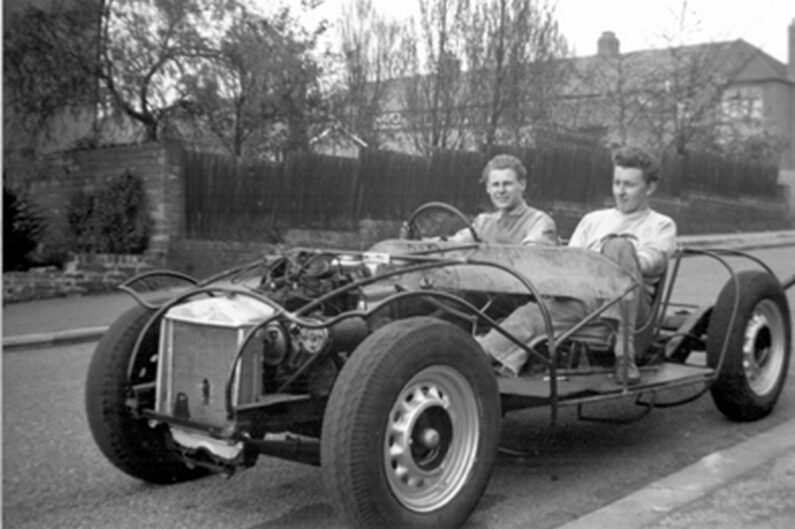
The superleggera construction ie welded tubular body framework welded together by a man living close by who earned his living as a welder of wrought iron gate and railings. Tubular bending was accomplished with the aid of a strong / long plank of timber with a hole near one end. With the blind end on the ground and holding the top end the tube can be bent by levering via the hole. Symmetry was achieved by making the hoops in two halves and matching profiles. The part built vehicle had to be pushed up the hill for welding, many times. The centre body section and rear end were clad in 20 s.w.g. (0.036”) aluminium sheet, over an 18 s.w.g. (0.048”) strip and retained by many countersunk self tapping screws that were deliberately in tight holes, and never came loose over many long miles !
Not being a competent tinsmith the required multi-curved front bonnet, wings and air-intake had to be made by the fairly recent availability of fibre glass cloth embedded in curable epoxy resin. The same was used for the rear wings. To obtain the required shape a mould was needed. The economical way to make a mould is to use wall plaster, initially over a rough formed chicken wire base. Working outdoors with no weather protection is not tenable, especially in cold temperatures when frost could undo good work. Resort had to be made to a nearby rented garage. Layers of plaster are built up and shaped both wet and set until the desired shapes are created.
STYLING
Occasionally the car had to be wheeled out onto the road as the restricted viewing in the close proximity of the garage was not suitable. The styling was my own design and inspiration for the air intake was a formula 1 Vanwall racing car and for the rear wings an Austin Healey 100. On one such viewing it was realised that the snub nose was too short. Jaguar’s D type models started of with short noses, but as a result of their 24 hour le Mans experience they lengthened theirs; I did the same but without the prospect of going to le Mans.
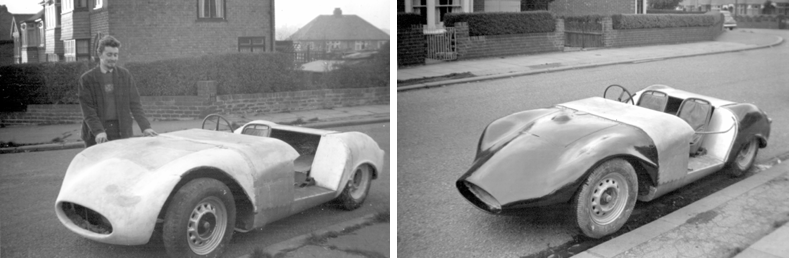
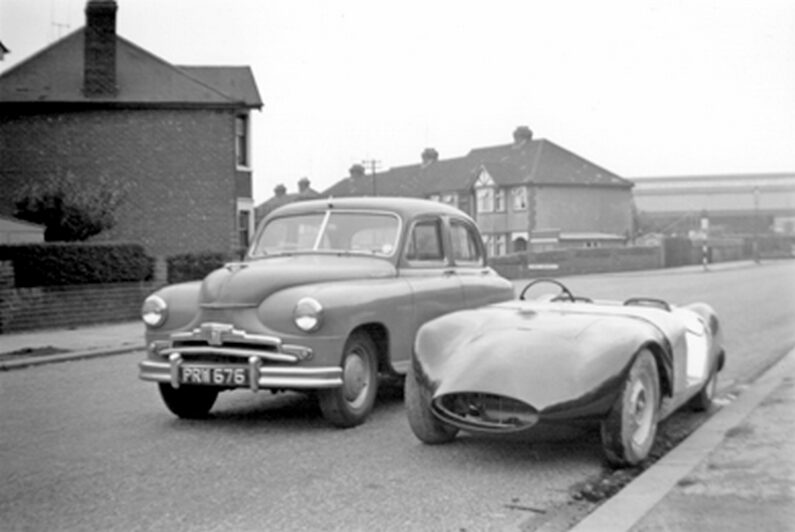
Ideally the male moulds should be used for making corresponding female moulds. That was way beyond my resources and capabilities: So when the mouldings were made the perfect smooth surface was on the inside, the outsides needed more resin and rubbing down to achieve a nearly smooth surface.
When the side and brake ilghts were fitted they were Lucas rubber circular bodied with clear or red lenses, with a chromium plated trim held in place by the rubber. Twin filament bulbs were fitted front and rear. The original intention was to have built-in headlights with curved plastic windows. I couldn’t afford headlamps and had made no provision for them in the plastering phase. It was another step too far for my resources and capabilities.
DRIVING
Fortunately in my wiring of the car I had powered both front filaments. Putting the car on the road coincided with the opening of the M1 and M45 motorways. I decided in the late afternoon to take a spin down the motorways, It was further than I realised and I had to return in the dark with only bright sidelights. Eventually I had to settle on Lucas fog and spot lights mounted externally, they were also controlled by a dip switch.
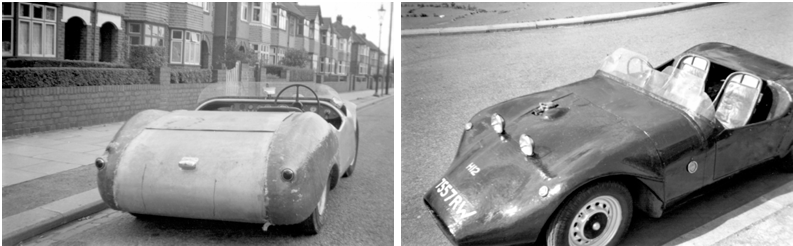
The carburettor was changed to a down-draft SU of 1.5” bore, mounted on a generously sized fabricated tubular steel inlet manifold. The exhaust down-pipes were made from copper tube which was the only material I could manipulate into a swan-neck to clear the steering column. The four downpipes ( bunch of bananas ) merged into two and led to a twin bore straight through homemade silencer, with asbestos rope and crimped stainless steel wire. We were ignorant then of the health risks associated with asbestos.
The silencer was contained within the body and discharged just ahead of the right hand rear wheel. It gave a lovely sound without being too noisy. With no instrumentation to determine the correct air / fuel ratio I had to rely on experimentation. I had obtained a set of different needles for the SU carburettor and resorted to driving around and changing the needles. I obviously was going the wrong way when I realised that the carburettor was supplying more fuel than the engine could burn, and neat petrol was going to an unsealed exhaust ! I stopped and leaped out of the car fearing it might be written off by a fire. When it cooled down I gingerly changed to a weaker needle.
I never got around to weighing the car or measuring its performance, it was fairly brisk by the standards of the days, but top speed was almost 80 mph accompanied by a lively ride at that speed ! It looked faster than it went, its ride wasn’t too bad, but don’t ask about refinement.
Looking back I’m amazed by my achievements, good fortune and ignorance. I we had an awful lot of fun both building and driving our respective Specials. Later as a qualified car chassis engineer I realised that there is a lot more to the subject that I knew then, and the Specials benefitted our engineering careers.
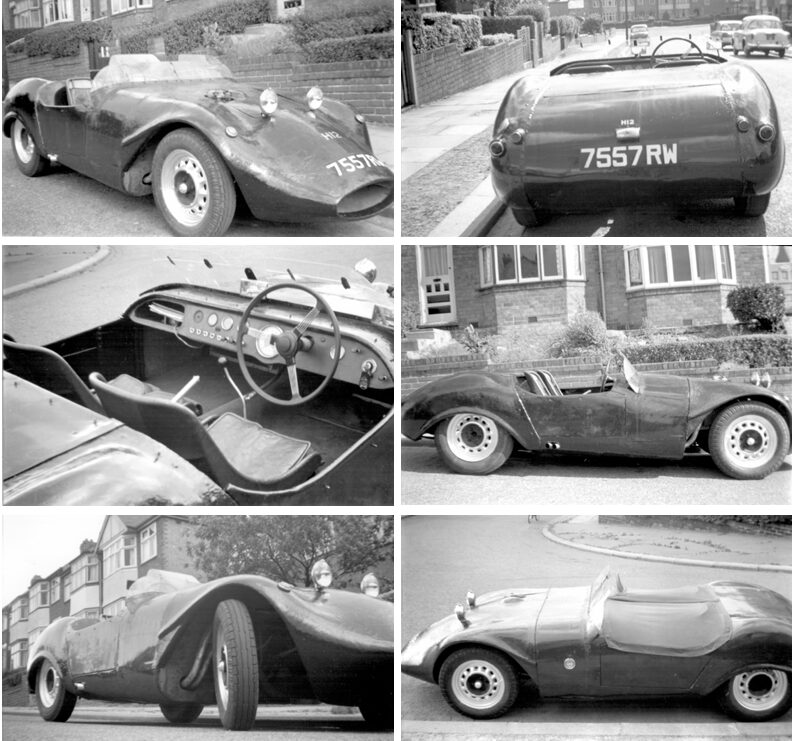
Martin WOOLSTON and the late Rex HOLBROOK. 2024 August 29
A NOTE FROM THE EDITOR OF THE CSI BLOG–
I worked with Martin for a short time, in the mid 1960s, when we were both employed as design draughtsmen in the Rootes Group drawing office, located in Humber Road Coventry. I moved on to other car manufacturers, spending thirty two years with Chrysler U.K./Peugeot mostly as a manager in the marketing department, leaving Martin to pursue his career at Rootes.
Our paths didn’t cross again until three years ago when we both attended a Rootes Heritage day held at the British Motor Museum, Gaydon. We have kept in touch since, mainly because of Martin’s interest in discovering more on the ill fated Hillman Swallow car. I have been pleased to help Martin in his writing of an article summarising his research on that car. This will shortly appear in an edition of the Rootes Archive Centre Trust’s Gazette newsletter.
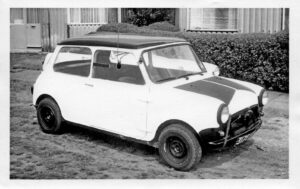
I didn’t know anything about Martin’s two specials and his meticulous recording of their histories until recently. What a fascinating story it is, my only foray into similar activities, in my early 20s, was to rebuild an old Mini with the objective of entering it into the 750 Motor Club’s Mini race series. Nothing so ambitious as Martin and Rex’s epic endeavours but enough for me to empathise with the story.
You might also like this post which also has a strong Rootes Group connection –
Nick
Note –
This article and the photographs contained within is subject to copyright and should not be republished in part or as a whole without permission from the author.
© carsceneinternational.com